Athlete Assist Mechanism — Rotary-to-Linear Actuation
 images/hero-image-athlete-assist.jpg
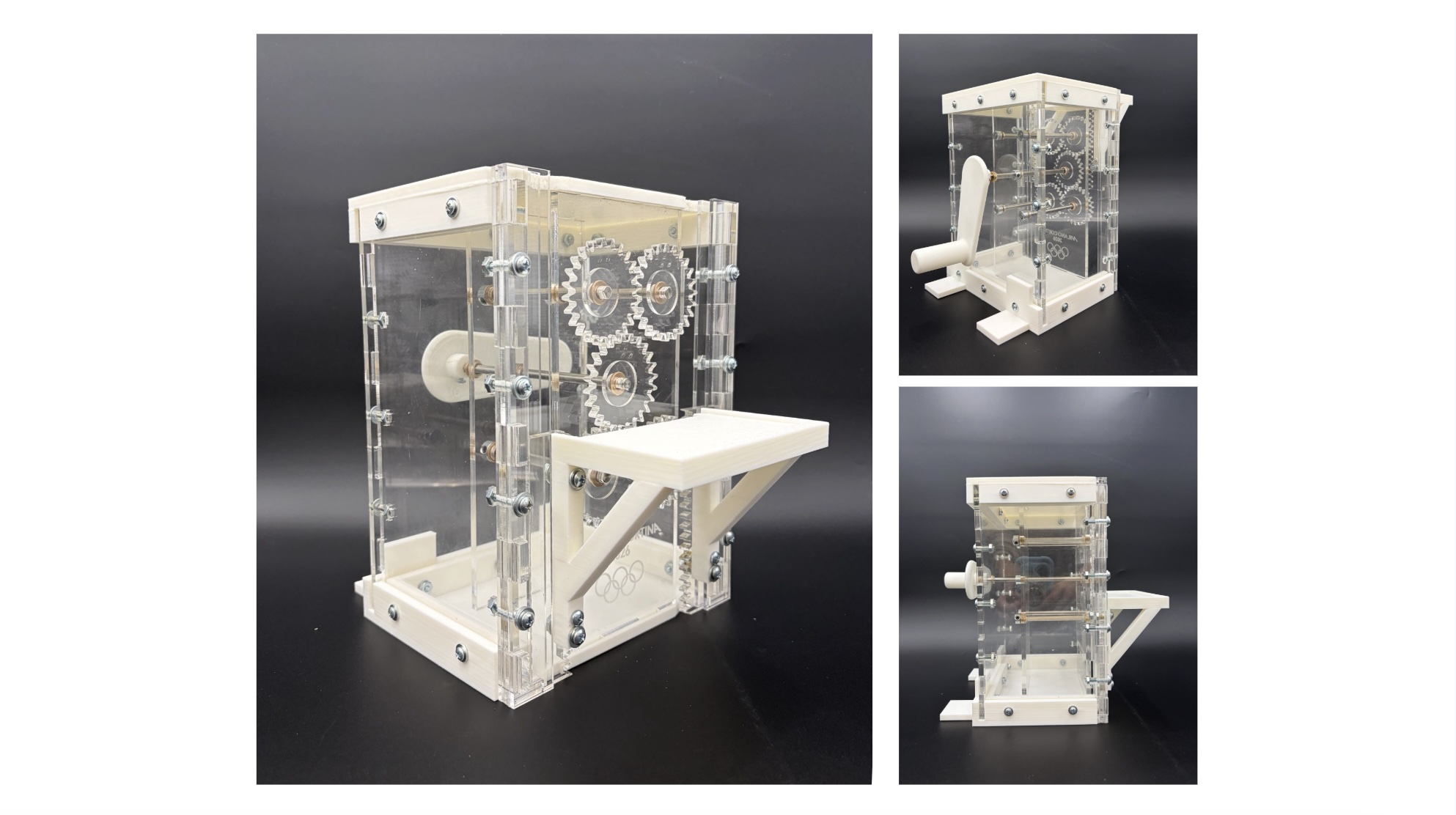
In a group of two, we designed a rotary-to-linear actuation mechanism to lift a 2.5 lb load vertically by 6 inches while remaining within a 12″ × 12″ × 12″ design envelope. The system converts rotational motion into precise linear displacement without the use of cables, pulleys, or winches.
The final design uses a dual rack-and-pinion mechanism. Driving the carriage from both sides distributes the load evenly, reducing bending moments and preventing the carriage from twisting or binding. A major design decision was using a shorter rack that passes through multiple pinions rather than a single long rack, which reduced the extended mechanism height.
The geometric alignment of the gear train was especially interesting to solve. Each of the five pinions' pitch diameter, center-to-center spacing, and rack pitch had to satisfy involute gear geometry so every gear meshed correctly while both racks remained perfectly parallel. Small dimensional errors would accumulate across the mechanism, causing backlash, uneven loading, or rack binding. Careful CAD modeling and tolerance analysis ensured proper gear spacing and synchronized linear motion across the entire travel.