Mass-Optimized Canine Prosthetic
 images/hero-image-canine-prosthetic.jpg
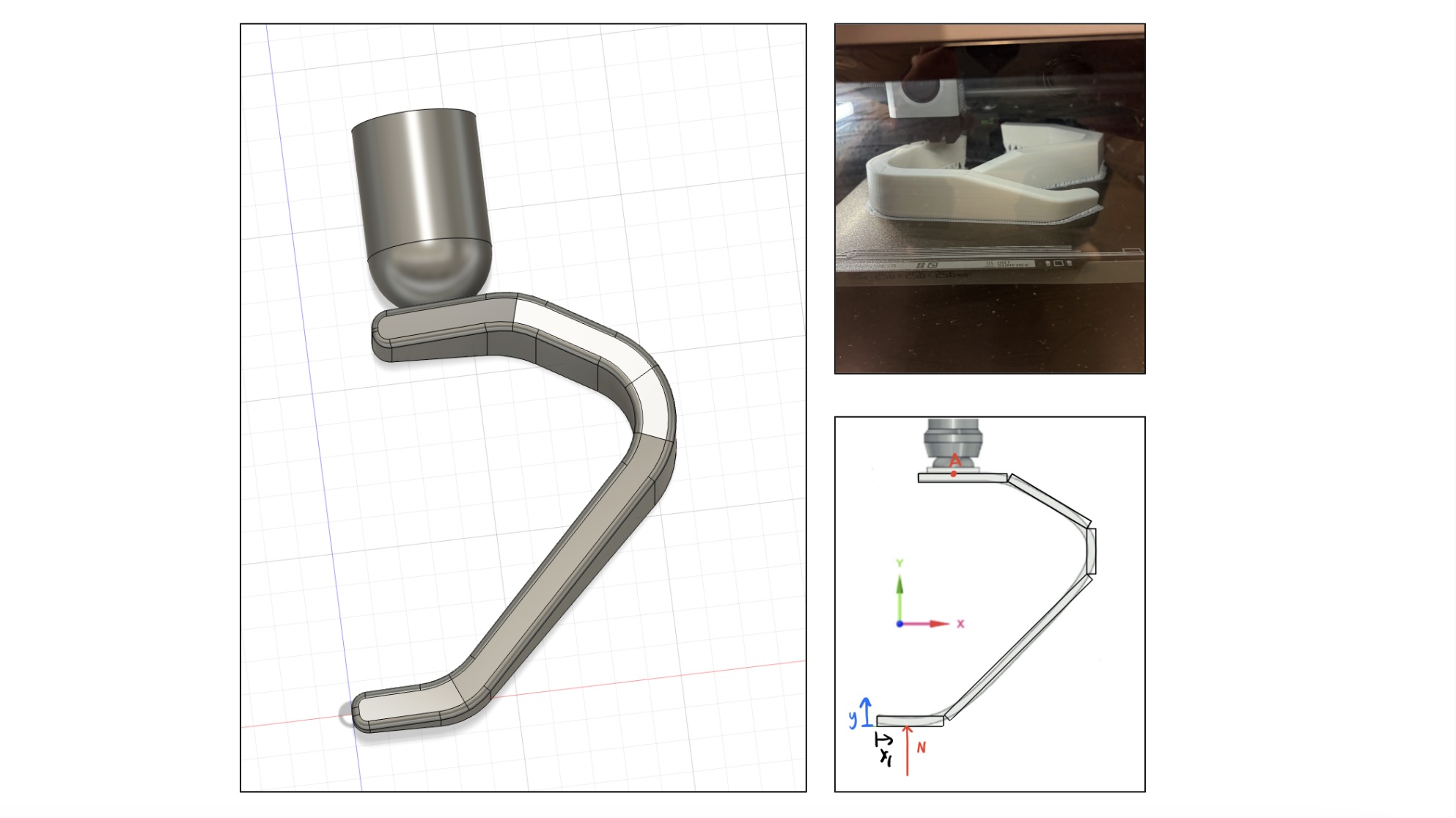
A mass-optimized J-shaped running blade, designed for a medium-sized dog with a transtibial (below-knee) hind-limb amputation, built with two teammates for ME80. The blade works as an elastic spring: it stores strain energy as it bends through stance and gives that energy back at push-off, which matters most for a dog's hind limbs, since that's where most of the forward thrust for running and jumping actually comes from.
The blade was modeled as five rigidly connected beam segments, fixed at the limb attachment and loaded with three times the dog's body weight to represent running and jumping. Solving for the internal axial force, shear, and bending moment along each segment produced a closed-form expression for exactly how wide the blade needed to be at each of the five linear segments. A separate buckling check confirmed that bending, not buckling, was the crucial design parameter.
Fusion 360 FEA supported the hand calculations closely: a predicted factor of safety near 2.0 as designed for, with peak stress within 1% of what the analytical model expected. A full-scale PLA prototype then held 70 lb on a gym weight machine without yielding, as needed for the load application.